
Facing the Hardest Part of Any Task: Why the “Hole” Is the Key to Beating Avoidance
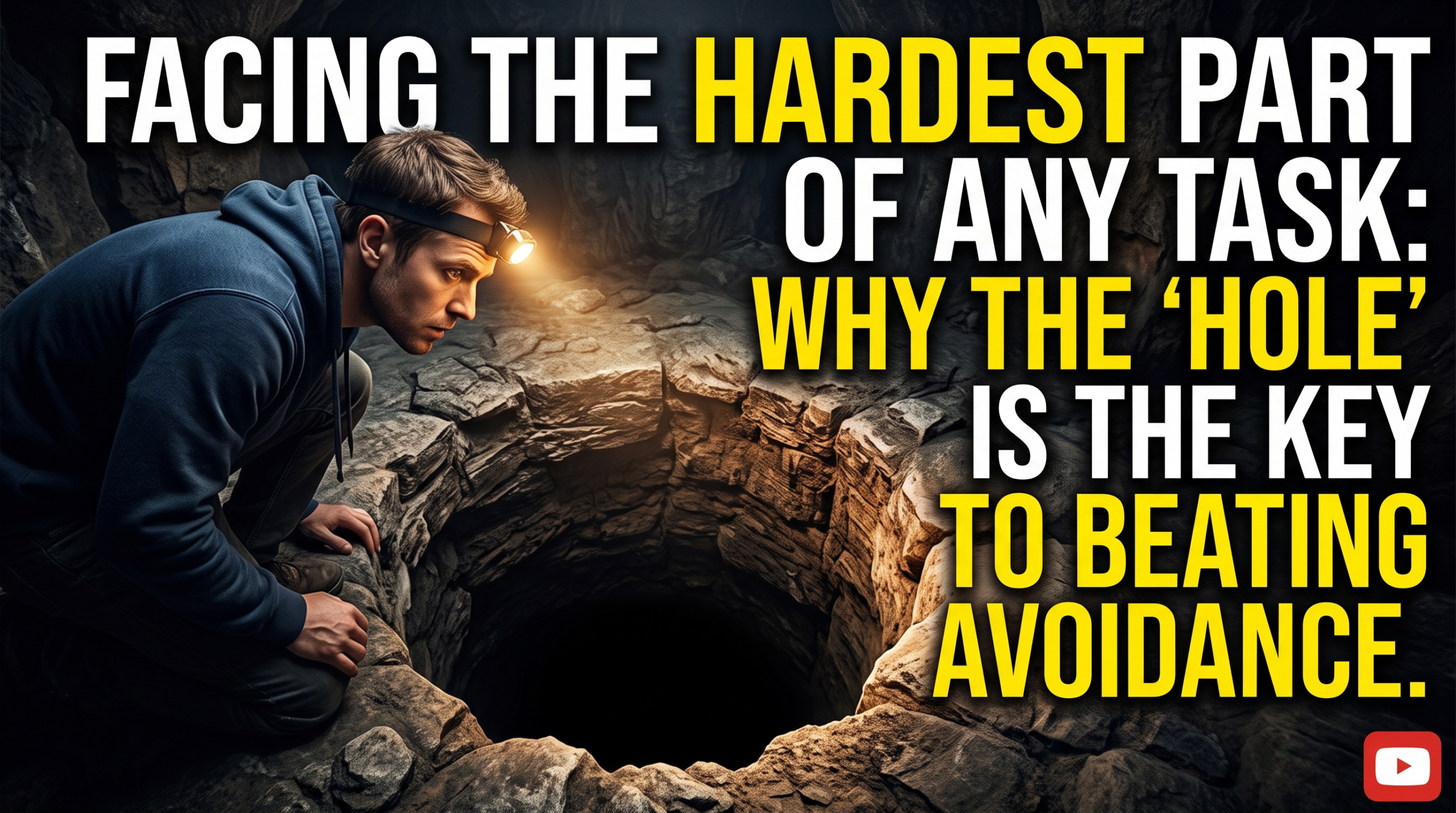
Most of the tasks we put off are not actually difficult from start to finish. They only feel that way because of a single moment buried somewhere inside them — a moment so uncomfortable that our minds decide the entire task is a threat worth avoiding. We call this moment “the hole,” and learning to sit inside it, rather than rush past it, is one of the most reliable ways to dissolve chronic procrastination.
What We Mean by “The Hole”
Every recurring source of avoidance in our lives has a specific low point. It is the point where a workout gets hardest, where a difficult phone call turns confrontational, or where a pile of unopened mail finally has to be sorted. We rarely dread the whole task. We dread that one moment, and our imagination inflates it until the entire task feels unbearable.
This pattern shows up across very different domains:
- Physical training: the bottom of a heavy squat, the last unbearable seconds of a sprint
- Financial tasks: actually opening the banking app and looking at the number
- Interpersonal situations: the sentence where we finally say the hard thing out loud
- Household chores: the moment a closet or drawer is completely emptied and looks worse before it looks better
In each case, the hard part is short. It might last five seconds, or five minutes. The avoidance it produces, on the other hand, can last for years.
Why Our Minds Rush to Escape Discomfort
Avoidance is a survival instinct operating in the wrong context. The brain treats sustained discomfort — physical strain, financial uncertainty, social risk — as a signal to retreat, because for most of human history, prolonged exposure to a threat was genuinely dangerous. Modern hard parts rarely carry that kind of risk, but the nervous system still reacts as if they do.
This creates a predictable cycle:
- We anticipate the hard moment and feel a spike of dread.
- We either avoid the task altogether or rush through the difficult moment as fast as possible.
- Because we never stay in the discomfort long enough to learn it is tolerable, the dread returns at full strength next time.
The cycle repeats indefinitely because speed and avoidance both deprive us of the one thing that would actually shrink the fear: familiarity.
The Alternative: Practicing the Hard Part on Purpose
The way out of this cycle is counterintuitive. Instead of minimizing time spent in the difficult moment, we deliberately extend it, under conditions low-stakes enough to make that tolerable. In strength training, this looks like pausing at the hardest point of a lift with a lighter load instead of exploding through it. In everyday life, the same principle applies to any task with a dreaded moment buried inside it.
The mechanism is straightforward: repeated, voluntary exposure to a manageable version of the hard part teaches the nervous system that the moment is survivable. Once that lesson sticks, the anticipatory dread that used to drive avoidance loses its grip — not just for that specific task, but for the whole category of situations that share the same “hard part.”
How to Find and Practice Your Own “Hard Part”
Applying this to daily life starts with a short diagnostic process rather than sheer willpower.
Step 1: Isolate the exact moment you dread. Most tasks we avoid are not uniformly hard. Ask what specific second, sentence, or action inside the task actually triggers the resistance. Naming it precisely shrinks it immediately.
Step 2: Design a low-stakes version of that moment. If the dreaded moment is opening a stack of bills, practice with a single envelope. If it is a hard conversation, rehearse the opening sentence with someone low-pressure before the real one.
Step 3: Stay in it slightly longer than feels comfortable. The goal is not to rush through the low-stakes version either. Sitting with the discomfort for even a few extra seconds is what builds tolerance.
Step 4: Repeat on a schedule, not just when motivation strikes. A single successful attempt rarely changes the underlying pattern. Consistent, scheduled repetition — weekly bookkeeping instead of a once-a-year scramble, for example — is what converts a dreaded task into a routine one.
Where This Mindset Pays Off Most
Some categories of avoidance respond especially well to this approach because they involve a single, identifiable “hard part” rather than diffuse difficulty:
| Area of Life | Typical Hard Part | Low-Stakes Practice |
|---|---|---|
| Personal finances | Seeing the actual balance or debt total | Check the number daily instead of monthly |
| Physical fitness | The point of maximum exertion | Train that specific point with lighter loads |
| Difficult conversations | The first sentence that breaks the silence | Rehearse the opening line out loud |
| Household organization | The mid-task mess before things improve | Tackle one small drawer or shelf at a time |
| Professional communication | Making the phone call instead of emailing | Make one low-stakes call per day |
Across all of these, the underlying skill being built is the same: tolerance for a specific, identifiable moment of discomfort, developed through repetition rather than force.
The Long-Term Payoff
Once the hard part of a task becomes familiar rather than threatening, the entire task changes category in the mind — from something to dread and delay, to something that simply gets done. This is why the effects of this practice tend to generalize far beyond the original task. Getting comfortable with the specific discomfort of financial review, for instance, often reduces avoidance around other numbers-based tasks entirely unrelated to money.
The goal is not to eliminate difficulty. It is to stop treating the hardest moment of a task as a reason to avoid the whole thing, and instead treat it as the one part worth practicing directly.