

Plan Tonight, Win Tomorrow: The Evening Planning Habit That Changes Everything
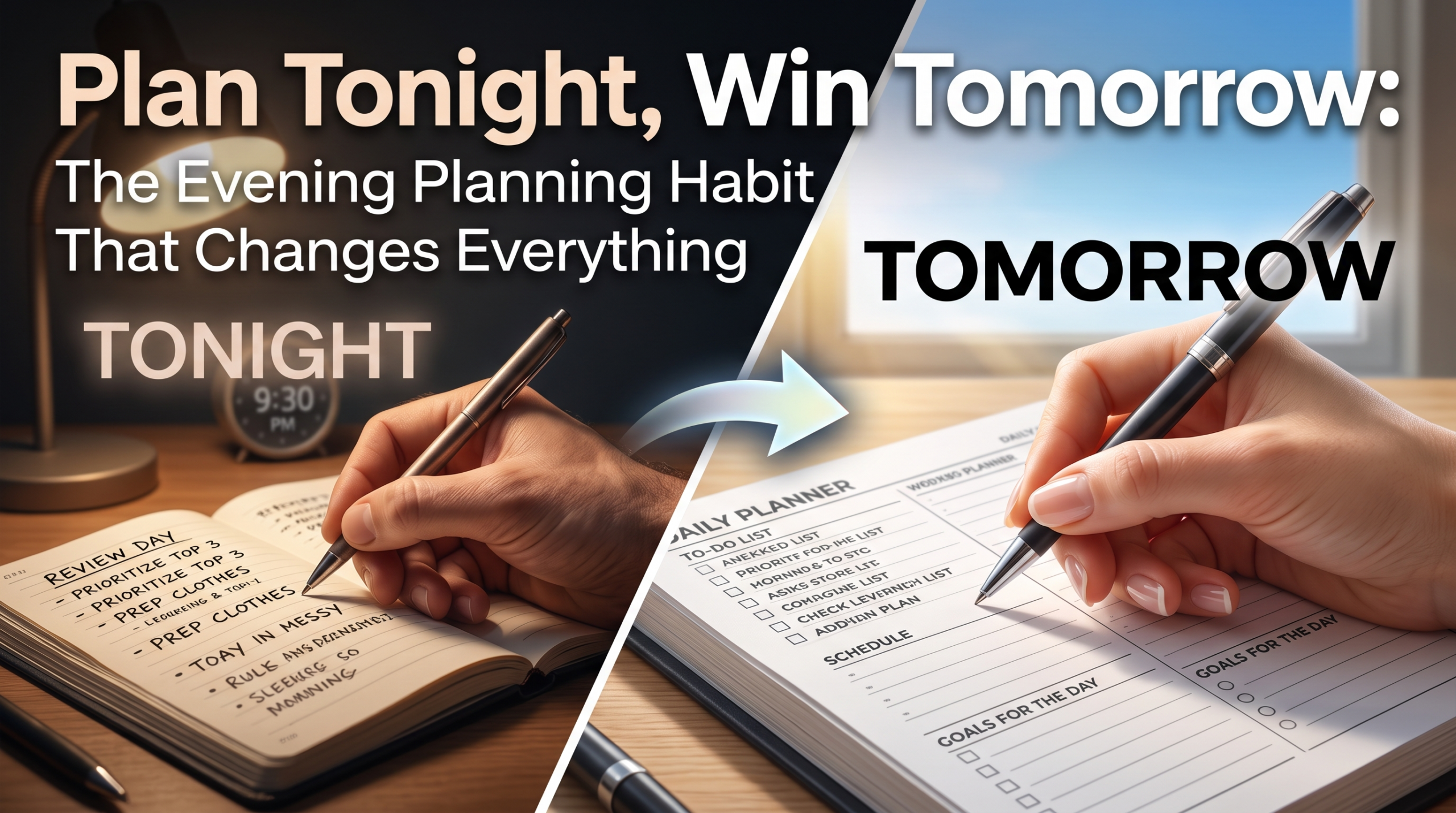
We’ve all had mornings that start with good intentions and end in chaos. We wake up, reach for coffee, and open our inbox before our feet have even settled into the day. An hour later, we’ve answered six emails, scrolled through three apps, and accomplished nothing that actually mattered. By the time we sit down to do real work, half the day is gone and our energy is already spent.
The problem isn’t a lack of discipline. It’s a lack of a plan.
Why We Fail to Plan Our Days
We plan weddings. We plan vacations. We plan grocery runs down to the last ingredient. Yet when it comes to the single resource we can never get back — our time — most of us wing it. We glance at a calendar, note a meeting or two, and improvise the rest.
This approach feels flexible, but it’s actually the opposite. Without a plan, we default to whatever is loudest and easiest: notifications, unread messages, other people’s priorities. We spend our best hours reacting instead of building.
The most productive people we can study, from historical figures to modern executives, share one trait: they treat their day as something to be designed, not discovered. Benjamin Franklin famously structured his day hour by hour, right down to a nightly reflection on what he’d accomplished. That structure wasn’t rigidity for its own sake — it was a way of making sure his limited hours went toward what mattered most to him.
The Power of Planning the Night Before
Here’s the insight that changes everything: the best time to plan your day isn’t the morning of. It’s the night before.
Planning in the morning means planning while distracted, groggy, and already behind. Planning the night before means designing your day while you’re calm, reflective, and not yet under pressure to perform. It also means you wake up with a decision already made — no wasted willpower deciding what to do first, because you already know.
This single shift, done consistently, tends to produce three concrete benefits:
- A faster start. Instead of a slow, foggy ramp-up, we open our eyes already knowing our first move.
- Fewer wasted hours. Unscheduled time is time that defaults to distraction. A plan claims that time before email or social media can.
- Better meetings. Reviewing tomorrow’s meetings tonight gives us a chance to think about what we actually want from each one, rather than walking in cold.
Building Your Evening Planning Routine
The good news is that this doesn’t require an elaborate system or expensive software. A simple, repeatable structure is enough — and simplicity is exactly why it works. Here’s a framework we recommend building into your evening routine.
Step 1: Review Tomorrow’s Calendar First
Start by pulling up tomorrow’s schedule. Transfer every meeting and appointment onto your plan, but don’t stop at just the time — jot a note on what you want to get out of each one. A meeting without a purpose in mind is a meeting that tends to waste everyone’s time.
Step 2: Block Every Hour, Not Just the Busy Ones
This is the step most people skip, and it’s the one that matters most. Once your meetings are down, you’ll notice gaps: 9 a.m., 2 p.m., late afternoon. Those gaps are dangerous. Left unclaimed, they get filled automatically by whatever demands your attention loudest — usually email or minor interruptions.
Instead, assign each open hour a real task. It doesn’t need to be dramatic. It just needs to be intentional. A day where every hour has a purpose, even a modest one, will outperform a day left to chance almost every time.
Step 3: Capture the Overflow To-Do List
Not everything fits neatly into an hourly slot. Keep a short list of remaining tasks — the follow-ups, the loose ends, the things that came to mind while planning. This becomes your buffer list: the tasks you reach for the moment an hour opens up unexpectedly.
Step 4: Choose Your First Task
This is the step that makes the entire system work. Before you close out your evening, decide on the one task you’ll start with tomorrow morning. You don’t need to finish it — you just need to start it. Deciding this in advance removes the single biggest source of morning friction: the blank-page moment of “what should I even do first?”
Step 5: Write Down What to Keep in Mind
Finally, note a few reminders for the day ahead — a personal goal, an affirmation, a birthday, or simply something you don’t want to lose sight of once the day gets busy. These small prompts act as anchors, pulling your attention back to what matters whenever the day starts to pull you off course.
Making the Habit Stick
A plan only works if you actually see it. A few small habits make the difference between a plan that gets followed and one that gets forgotten:
- Keep it visible. Whether it’s a notebook, a sticky note, or a digital doc, place it somewhere you’ll see first thing in the morning — ideally with your first task facing you.
- Keep it with you. A plan tucked away in a drawer won’t help you at 2 p.m. when focus starts to slip. Keep it accessible throughout the day.
- Keep it short. Ten minutes is the target. If planning tomorrow starts eating into an hour, the system has become the very distraction it was meant to prevent.
The Long-Term Payoff
None of this guarantees a perfect day. Meetings run long, priorities shift, and unexpected fires still need putting out. But a day built on a plan — even one that gets disrupted — will almost always outperform a day built on none. The difference compounds. A single planned evening produces one better morning. A habit of planned evenings produces months, and eventually years, of days that were spent on purpose instead of by accident.
The most successful people we know of didn’t get there by working harder in the moment. They got there by deciding, the night before, exactly how that moment would be spent.