How to Learn Anything Fast: The 7-Step System to Master Any Skill
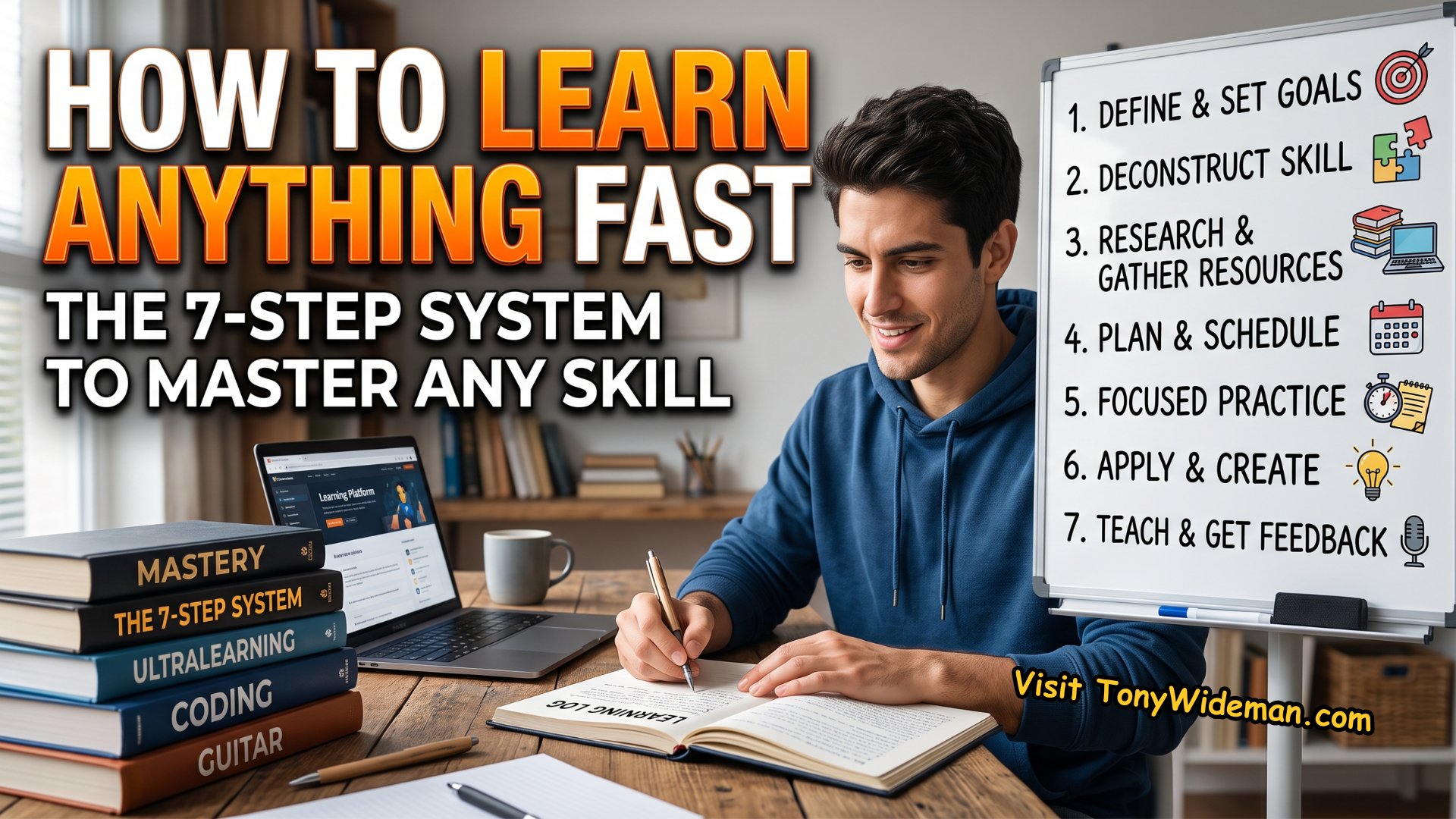
Learn Anything Fast
Fast learning is a system, not a talent. We cut the path to mastery by combining deliberate practice, skill decomposition, expert feedback, peer learning, retrieval practice, energy management, and daily compounding. Each step below includes the reasoning, the method, and a concrete way to apply it.
The 7-Step Framework to Master Any Skill Faster
The 10,000-Hour Rule: What It Really Says About Mastery
The 10,000-hour rule is the most quoted and most misread idea in skill acquisition. It comes from research by psychologist Anders Ericsson on violinists at a Berlin music academy. The top group had accumulated an average of roughly 10,000 hours of practice by age 20. Malcolm Gladwell popularized that average in Outliers and turned it into a universal threshold.
Ericsson later corrected the simplification in his book Peak. Three points matter:
- 10,000 was an average, not a threshold. Some performers reached elite levels with fewer hours, and others needed far more.
- The type of hours matters more than the count. Ericsson’s term is deliberate practice: focused, structured work at the edge of current ability, with immediate feedback.
- The figure is specific to highly developed fields. It applies to domains with mature training methods, such as classical music and chess, and does not transfer to every skill.
Hours help only when they are the right hours. We can shorten the path by raising the quality of each hour instead of chasing the total.
What Is Deliberate Practice and How Does It Differ From Regular Practice?
Deliberate practice is purposeful, feedback-driven training aimed at a specific weakness. Regular practice repeats what we already do well.
| Dimension | Regular practice | Deliberate practice |
|---|---|---|
| Goal | Put in time | Improve one specific sub-skill |
| Difficulty | Comfortable | Just beyond current ability |
| Feedback | Rare or delayed | Immediate and specific |
| Attention | Often on autopilot | Fully concentrated |
| Outcome | Plateau | Measurable progress |
Consider two chess players who each log 5,000 games. One plays the same openings and repeats the same mistakes. The other reviews every loss, studies master games, and drills endgames. After 5,000 games, the second player is far stronger, because repetition alone does not produce improvement.
Step 1: Break Any Skill Into Micro-Skills
Every complex skill is a bundle of smaller, separable skills. Learning gets faster when we practice those components individually instead of the whole at once.
Take a business as an example. Sales, negotiation, hiring, team management, product development, fundraising, and emotional resilience are distinct competencies. Being strong at sales does not make someone strong at management. Chess breaks down into openings, tactics, positional play, endgames, and time management. Public speaking breaks down into structure, vocal delivery, pacing, stage presence, storytelling, and handling questions.
How to Build a Micro-Skill Map
- Write the skill at the top of a page.
- List every component by studying how experts describe the field, reading syllabi and job descriptions, and asking practitioners what separates beginners from professionals.
- Rate each micro-skill from 1 to 5 on current ability.
- Rank by impact. Identify the two or three micro-skills that limit overall performance.
- Assign practice blocks to the weakest high-impact skills first.
| Skill | Sample micro-skills | Typical bottleneck |
|---|---|---|
| Writing | Research, structure, clarity, voice, editing | Editing |
| Programming | Syntax, debugging, data structures, system design, testing | Debugging |
| Language learning | Vocabulary, listening, pronunciation, grammar, conversation | Listening |
| Investing | Valuation, risk management, psychology, position sizing | Psychology |
Decomposition also turns an overwhelming goal into daily actions. “Learn to speak Spanish” becomes “learn 20 high-frequency verbs and drill their present-tense forms today.”
Step 2: Structure Deliberate Practice Sessions for Faster Skill Growth
A well-built session has a fixed shape. We recommend 45 to 90 minutes of focused work, since concentration degrades beyond that for most people. Pick one micro-skill. Set a measurable target. Practice at the edge of ability. Get immediate feedback. Adjust the approach
Four rules keep sessions productive:
- Target one micro-skill per session. Splitting attention slows learning.
- Define success in advance. “Play the passage at tempo with no errors three times in a row” is a target. “Practice piano” is not.
- Work where it is uncomfortable. If the practice feels easy, it is maintenance, not growth.
- Record and review. Video, audio, and written logs turn performance into data. Comedians, athletes, and speakers who review recordings frame by frame improve faster than those who rely on memory.
Step 3: Build a Learning Network of Mentors, Peers, and Students
Skills grow faster inside a network. We organize that network into three roles.
Mentors: Learn From People Ahead of You
A mentor shortens the feedback loop by spotting errors we cannot see ourselves. Mentors come in two forms:
- Direct mentors who review our work, such as coaches, senior colleagues, and tutors.
- Indirect mentors who teach through books, lectures, interviews, and recorded performances.
Educational psychologist Benjamin Bloom found that students who received one-to-one tutoring with mastery-based methods performed about two standard deviations above students in conventional classrooms. That result, known as the 2 sigma problem, shows how much expert feedback contributes.
Indirect mentorship scales cheaply. Reading widely in a field and studying the best practitioners’ work gives us access to expert thinking at almost no cost. To retain what we read, we write down the ten most important lessons immediately after finishing. Without that step, most of the material fades within days.
Peers: Learn With People at Your Level
Peers working toward the same goal are underrated. They face the same problems at the same time, which makes their questions and solutions directly relevant. Poker players compare difficult hands. Investors compare these across strategies. Developers review each other’s code.
Peers can get into the details of a beginner’s problems in a way advanced mentors often cannot, because mentors have moved past that stage. A weekly study group, a shared practice log, or a small mastermind gives us accountability, alternative approaches, and steady motivation.
Students: Learn by Teaching
Explaining a concept exposes every gap in our understanding. The Feynman technique formalizes this:
- Choose a concept.
- Explain it in plain language as if teaching a beginner.
- Note where the explanation breaks down or relies on jargon.
- Return to the source material to fill those gaps.
- Simplify the explanation again.
Beginners also ask basic questions that force us to rehearse fundamentals. Writing, mentoring newcomers, and answering questions in communities all build this habit. You Mentors: correct your errors. Peers: share problems and solutions. Students: expose gaps by teaching
Step 4: Use Failure as a Learning Accelerator
Failure is inevitable in any skill worth learning, and it carries more information than success does. When something works, we rarely know which factor caused it. When something fails, the error is usually specific and traceable.
Ray Dalio’s formula, “Pain + Reflection = Progress,” describes the mechanism. Pain alone does not teach. The reflection does. A repeatable review process turns setbacks into skill:
- Record the outcome immediately, while details are fresh.
- Identify the micro-skill that failed.
- Separate decision quality from luck. A good decision can produce a bad result, and the reverse.
- Consult a mentor or peer for an outside view.
- Design a drill targeting the specific weakness.
- Repeat the situation to test the fix.
Design Small, Frequent Failures
Long projects can hide failure for months. We shorten the feedback cycle by creating mini-failures on purpose:
- Set deadlines shorter than comfortable.
- Test a product idea with ten customers before building it.
- Perform in front of a small audience before a large one.
- Play against stronger opponents.
- Publish rough drafts and collect criticism early.
Small, frequent failures deliver the lessons of large ones at a fraction of the cost.
Step 5: Use Retrieval Practice and Spaced Repetition to Retain What You Learn
Speed means little if knowledge does not last. Two well-established techniques improve retention.
Retrieval practice means testing ourselves instead of rereading. Research on the testing effect, including work by Henry Roediger and Jeffrey Karpicke, shows that recalling information strengthens memory more than reviewing it. Practical forms include flashcards, closed-book summaries, practice problems, and explaining ideas from memory.
Spaced repetition means reviewing material at growing intervals. Hermann Ebbinghaus’s forgetting curve showed that memory decays quickly without review. Each well-timed review flattens the curve and extends retention.
| Review | Timing |
|---|---|
| First | Same day |
| Second | 1 day later |
| Third | 3 days later |
| Fourth | 1 week later |
| Fifth | 3 to 4 weeks later |
Interleaving, which mixes different problem types within a session, is another strategy with strong evidence. It feels harder than practicing one type at a time, but it improves long-term performance. Psychologist Robert Bjork calls this kind of effortful learning a desirable difficulty.
Step 6: Manage Energy Because Learning Depends on Your Physical and Mental State
Learning consumes cognitive resources, and a depleted brain retains less. We treat energy as the foundation of the whole system and manage it across four areas.
Physical Health: Sleep, Movement, Nutrition
- Sleep consolidates new memories and motor skills. Regular, sufficient sleep supports retention.
- Exercise, particularly aerobic activity, is associated with better memory, attention, and mood.
- Nutrition and hydration affect concentration across the day.
Emotional Health: Relationships and Environment
Constant conflict and chronic stress compete for the same attention that learning requires. Reducing draining relationships and building supportive ones frees mental capacity for practice.
Creative Health: Generate Ideas Daily
Writing down ten ideas a day is a simple habit that trains the brain to connect concepts across domains. Combining ideas from different fields is a source of insight and original thinking.
Spiritual and Psychological Health: Manage Anxiety
Worry about the future and regret about the past consume attention. Meditation, journaling, therapy, and a clear distinction between what we control and what we do not all reduce that load. A calm mind absorbs more from each session.
Step 7: Apply the 1% Rule and Practice in Real Conditions
The Math of Compounding Improvement
A 1% daily improvement compounds. Over a year, 1.01 multiplied by itself 365 times equals about 37.8. Small gains accumulate exponentially instead of linearly.
| Days of 1% improvement | Multiple of starting level |
|---|---|
| 30 | 1.35× |
| 90 | 2.45× |
| 180 | 6.0× |
| 365 | 37.8× |
The reverse also holds. A 1% daily decline over a year leaves roughly 2.6% of the starting level. The 1% figure is a model, not a measurable quantity, since real progress is uneven. Its value is behavioral: it favors small, sustainable, daily improvement over rare bursts of effort.
Playing Is Not the Same as Improving
Someone who plays chess every day but never studies, reviews, or seeks feedback repeats the same mistakes. Volume without reflection produces a plateau. Each day should include at least one deliberate action: reviewing an error, learning a new pattern, or testing something unfamiliar.
Practice Under Real Conditions
Reading about a skill does not replace doing it. Chess players need tournament pressure. Founders need customers and payroll. Comedians need live audiences. Programmers need to ship code that others use. Real conditions expose skills that safe practice cannot reveal.
We apply the same rule to every domain: study, then perform, then review, then repeat. Performance is where knowledge becomes skill.
How Long Does It Take to Master a Skill?
Mastery has stages. The Dreyfus model of skill acquisition describes five: Novice: follows rules; Advanced beginner: recognizes patterns; Competent: plans and prioritizes; Proficient: sees the situation intuitively; Expert: acts fluidly from deep experience
Timelines vary widely by field, starting point, and practice quality. Josh Kaufman argues that roughly 20 hours of focused, structured practice can take someone from zero to a useful level of competence in many everyday skills. That claim covers basic competence, not expertise. Expert-level performance in complex fields still takes years. Experts hold vast libraries of stored patterns, which researchers studying chess masters describe as chunks, and those take sustained exposure to build.
The realistic conclusion is that structure shortens the beginner and intermediate stages dramatically, while the advanced stage continues to demand time. A better system reduces the hours required, and it does not remove them.
A 90-Day Plan to Learn Any Skill Faster
| Phase | Days | Focus | Key actions |
|---|---|---|---|
| Foundation | 1–14 | Map and baseline | Build the micro-skill map, rate current ability, record a baseline performance, find one mentor source and one peer group |
| Skill building | 15–60 | Deliberate practice | One micro-skill per session, daily review, weekly peer feedback, spaced flashcards |
| Pressure testing | 61–90 | Real conditions | Perform or ship weekly, review every failure, teach what you have learned, re-rate all micro-skills |
Daily minimum: 45 to 90 minutes of focused practice, one review of a mistake, and one retrieval exercise.
Weekly minimum: one performance in real conditions, one peer or mentor feedback session, and one energy audit covering sleep, exercise, and stress.
Common Mistakes That Slow Down Learning
- Consuming without producing. Reading and watching feel productive, but skill comes from output.
- Practicing what is already easy. Comfort produces plateaus.
- Skipping feedback. Practicing alone without correction cements errors.
- Avoiding failure. People who avoid losses also avoid the lessons inside them.
- Neglecting sleep and recovery. Cutting rest to gain hours reduces the return on those hours.
- Learning everything at once. Unfocused effort spreads thin across skills instead of improving any of them.
- Never reviewing. Without spaced review, most new material is forgotten.
Frequently Asked Questions About Learning Anything Fast
Can we really master a skill faster than 10,000 hours?
Yes. The 10,000-hour figure was an average from one study of elite violinists, not a requirement. Deliberate practice, expert feedback, and disciplined review raise the return on each hour, so many people reach high levels with fewer hours than the popular version of the rule suggests.
What is the fastest way to learn a new skill?
Break the skill into micro-skills, practice the weakest high-impact ones at the edge of ability with immediate feedback, review mistakes, and test what we know through retrieval practice. Daily consistency beats occasional long sessions.
How does the 1% rule work for learning?
The rule treats small daily gains as compounding. Improving 1% a day would yield about 37.8 times the starting level after a year. Actual progress isn’t this smooth, but the principle keeps you focused on steady improvement.
How important is a mentor?
Very. A mentor spots errors we cannot see and points us to the right practice. Books, courses, and recorded talks from experts serve as indirect mentors when direct access is not available.
How do we stay motivated through early failure?
We treat failure as expected data. Setting small, frequent challenges, recording progress, and learning alongside peers make early setbacks easier to interpret and keep going through.
Does sleep really affect learning?
Yes. Sleep supports memory consolidation and attention. Learning sessions followed by adequate sleep produce better retention than the same sessions followed by sleep loss.
The Bottom Line on Mastering Any Skill Quickly
Mastery comes from a repeatable system. We decompose the skill into micro-skills, practice deliberately, surround ourselves with mentors, peers, and students, learn from small failures, retain knowledge through retrieval and spacing, protect our energy, and compound small gains in real conditions every day. Whatever the skill, the approach is the same: focus on one weakness, get feedback, repeat.