
Take the Stairs: Why Choosing the Harder Path Builds a More Fulfilled Life
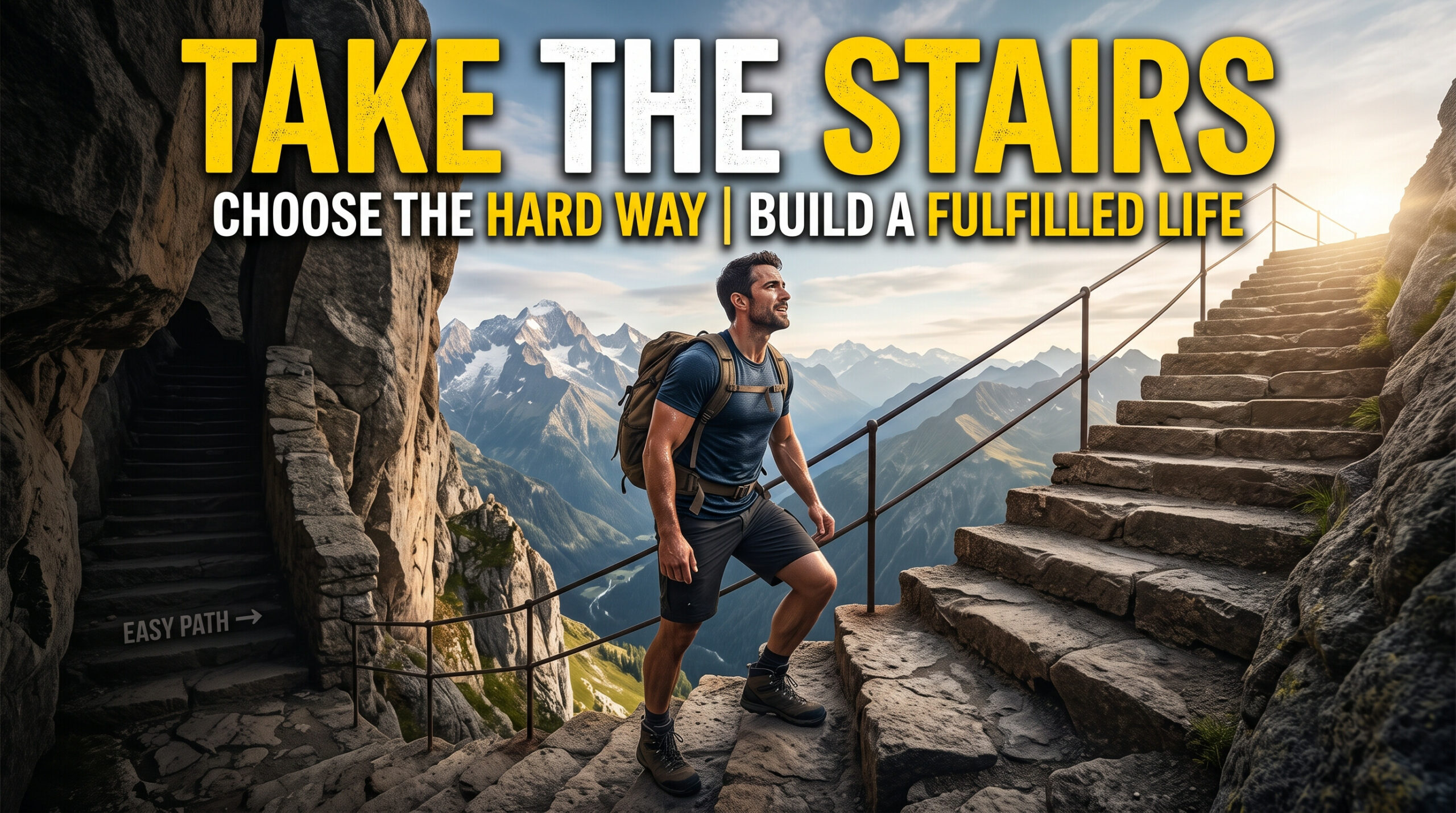
Every single day, we are handed a small, almost invisible decision that says more about our character than we realize: the elevator or the stairs. It sounds trivial. It isn’t. We believe this everyday choice is one of the clearest windows into how we approach discomfort, growth, and the pursuit of a genuinely fulfilling life. In this post, I will unpack why “taking the stairs” has become such a powerful metaphor for personal development, what the science says about effort and happiness, and how we can apply this philosophy to build a life defined by purpose rather than convenience.
The Elevator Mindset vs. The Stairs Mindset
We live in a culture engineered for frictionlessness. Food arrives at our door in fifteen minutes. Entertainment streams instantly. Answers appear before we finish typing the question. This is the elevator mindset: minimize effort, minimize discomfort, minimize time spent in the in-between.
The stairs mindset is the opposite. It says: the climb itself has value. It says: discomfort is not something to be eliminated but something to be metabolized into strength. People who adopt this mindset don’t chase the shortcut by default — they ask whether the shortcut is actually taking something away from them.
We are not arguing that convenience is evil. Elevators exist for good reasons — accessibility, efficiency, necessity. The metaphor isn’t a rejection of tools that help us. It’s a caution against a default setting that always chooses the path of least resistance, even when that path quietly erodes our resilience, our health, and our sense of accomplishment.
Why Small Choices Compound Into a Fulfilling Life
Fulfillment rarely arrives as a single dramatic event. It accumulates. Behavioral scientists have long pointed out that identity is built through repeated action far more than through intention. Every time we choose the stairs — literally or figuratively — we cast a small vote for the kind of person we want to become.
This compounding effect explains why people who consistently choose slightly harder, slightly more effortful paths often report a stronger sense of self-efficacy: the belief that their actions actually produce outcomes. Self-efficacy is one of the most reliable predictors of long-term life satisfaction, because it replaces helplessness with agency.
Consider three areas where the “stairs principle” quietly shapes long-term wellbeing:
- Physical health — choosing movement over stillness, even in small doses, has measurable cardiovascular and metabolic benefits that accumulate over years.
- Mental resilience — voluntarily seeking manageable challenges trains the nervous system to tolerate stress without spiraling into avoidance.
- Professional growth — taking on the harder assignment, the uncomfortable conversation, or the unfamiliar skill is almost always the actual path to mastery.
The Psychology of Earned Reward
There is a specific kind of satisfaction that only comes from effort. Psychologists sometimes call this “earned reward,” and it behaves very differently in the brain than a reward that requires nothing of us. A reward that costs us nothing tends to produce a brief spike of pleasure that fades quickly. A reward that required real effort — a summit reached on foot, a skill built through repetition, a goal met through discipline — produces a deeper and more durable sense of satisfaction.
This is why people who habitually avoid friction often describe their lives as comfortable but strangely empty. Comfort, taken as a permanent state rather than a temporary rest, dulls the very systems in us that generate meaning. We are, in a very real sense, wired to need resistance to feel alive.
Comfort Zones Are Not Safe — They Are Slow
One of the most persistent myths we encounter is the idea that the comfort zone is a place of safety. It is more accurate to describe it as a place of stagnation disguised as safety. Nothing bad appears to be happening inside the comfort zone, which is exactly what makes it so easy to stay there indefinitely. But life outside the comfort zone is where skills sharpen, confidence compounds, and identity solidifies.
Choosing the stairs is a small, repeatable act of leaving the comfort zone on purpose, on a schedule we control, before life forces us to leave it under far less forgiving circumstances — a layoff, an illness, a relationship rupture. Voluntary discomfort, practiced regularly in low-stakes ways, builds the exact muscle we need for involuntary discomfort later.
Reframing Effort as a Privilege, Not a Punishment
Language shapes perception. When we describe a hard task as a burden, our nervous system prepares to endure it. When we describe the same task as an opportunity — a privilege available to us because we are capable of it — our nervous system prepares to engage with it. This reframing costs nothing and changes everything.
We encourage a simple linguistic shift: replace “I have to” with “I get to.” I have to take the stairs becomes I get to move my body today. I have to have this difficult conversation becomes I get to practice honesty and courage. This is not naive positivity. It is a deliberate redirection of attention toward the value embedded in the effort itself.
Building a Personal “Stairs Practice”
Philosophy without practice stays theoretical. Below is a practical structure for turning the stairs metaphor into a lived habit.
- Identify one daily elevator. Choose one recurring moment where you default to ease — snoozing an alarm, scrolling instead of starting, delegating a task you should be doing yourself to grow.
- Replace it with a five-minute stair. The goal is not heroism; it is repetition. A five-minute version of the harder choice, done daily, outperforms a heroic version done once.
- Track completion, not outcome. Fulfillment research consistently shows that tracking whether we showed up builds identity faster than tracking results, which are often outside our control.
- Add friction back deliberately. Once a stair becomes automatic, introduce a new one. Growth requires a moving target of manageable difficulty.
- Protect recovery. The stairs philosophy is not about permanent hustle. Rest is part of the climb — it’s what allows the next flight to be climbed well.
What the Research Says About Effort and Wellbeing
Research into what psychologists call “hedonic adaptation” shows that we quickly grow numb to pleasures that require no effort — a phenomenon sometimes described as the hedonic treadmill. Effortful pursuits resist this numbing because they generate ongoing engagement rather than a single hit of pleasure. This is closely tied to the concept of “flow,” where challenge and skill are closely matched, producing some of the most consistently reported peak experiences of human life.
Longevity research adds another layer: populations with notably long, healthy lifespans tend to share environments that build movement and mild physical effort into daily life by default — walking to gather food, climbing terrain, physical work — rather than environments engineered to remove all effort. The lesson is not that suffering is good. It is that a life with zero built-in friction tends to produce weaker bodies, weaker minds, and thinner satisfaction.
Applying the Stairs Philosophy Beyond Fitness
While the metaphor originated with a literal staircase, its real power shows up far beyond the gym or the office stairwell.
In relationships: choosing the harder, more vulnerable conversation over the easier silence builds trust that avoidance never can.
In career decisions: choosing the stretch assignment over the safe, familiar task is almost always what separates steady growth from quiet plateau.
In creative work: choosing to finish and publish the imperfect piece, rather than endlessly polishing in private, is its own set of stairs — uncomfortable, but the only route to an audience, feedback, and improvement.
In financial habits: choosing to save or invest a little now, instead of spending for immediate comfort, is a financial staircase whose landing is reached only years later — but reached far more reliably than any shortcut.
The Long-Term Payoff of Choosing the Harder Path
None of this promises an easy life. It promises a richer one. People who consistently choose the stairs — literally and metaphorically — tend to describe their lives not as free of struggle, but as full of meaning derived from struggle they chose on their own terms. That distinction matters enormously. Struggle we choose builds us. Struggle that simply happens to us can just as easily break us if we haven’t built the capacity to meet it.
We believe the invitation is simple, even if the execution takes discipline: the next time an elevator and a staircase both stand in front of us, we can pause for one second and ask what kind of person we are choosing to become. Small as it seems, that one second, repeated across a lifetime, is very often the difference between a life that merely happened to us and a life we deliberately built.