
Freeganism and Primitivism: How Urban Foraging Became a Strategy for Social Change
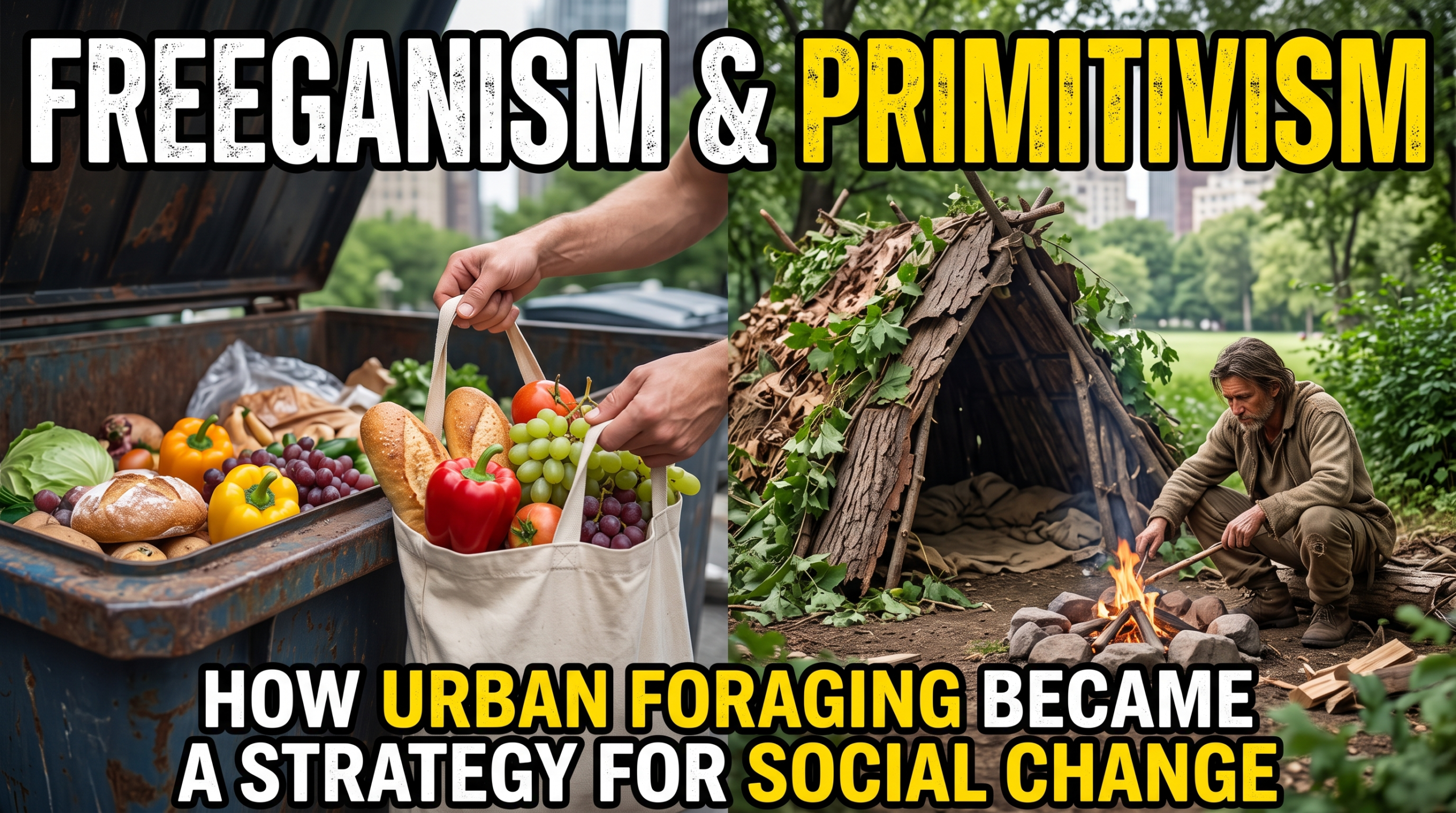
Freeganism sits at a fascinating crossroads of ecology, economics, and identity politics. We often hear the word tossed around in connection with dumpster diving, but the movement runs far deeper than a search for free food. It is, at its core, a rejection of the formal economy and a deliberate embrace of practices that reduce socio-ecological harm. In this post, we unpack what freeganism actually is, how it borrows from — and diverges from — primitivist thought, and why urban foraging has become one of its most visible and most misunderstood expressions.
What Is Freeganism? A Working Definition
Freeganism describes a lifestyle in which individuals, primarily young people in Western urban centers, choose to meet their material needs — food, clothing, shelter, and other essential services — without participating in conventional market exchange. The term itself blends “free” and “vegan,” signaling both a rejection of consumer capitalism and an ethical stance against waste.
Unlike simple frugality, freeganism is animated by a political critique. Practitioners argue that modern economies generate staggering amounts of surplus and waste, and that recovering and redistributing this surplus is both an ecological necessity and a form of quiet resistance. Dumpster diving — retrieving discarded but perfectly usable food, often from supermarket and restaurant bins — remains the most recognizable freegan activity, but the broader philosophy extends to squatting, bartering, skill-sharing, and communal living arrangements.
We should be careful not to conflate freeganism with poverty-driven scavenging. Most freegans choose this path voluntarily, often as a critique of abundance and inequality rather than as a response to scarcity. That distinction matters enormously when we start to examine the criticisms leveled against the movement.
Freeganism and Primitivism: Where the Two Philosophies Meet
Primitivism, as a cultural and political current, advocates a return to nature or to a more “wild,” pre-industrial state of human existence. It is deeply skeptical of technological modernity, arguing that industrial civilization has severed people from more authentic, embodied, and ecologically balanced ways of living.
Freegan practices can be productively read through this primitivist lens. Dumpster diving, urban foraging, and off-grid resourcefulness all echo primitivist yearnings for self-sufficiency and a reduced dependence on formal institutions. Freegans frequently describe their choices in language that evokes rewilding: reclaiming skills their grandparents once had, learning to identify edible plants, or treating the city itself as a landscape to be read and harvested rather than simply consumed within.
Yet freeganism is not primitivism in its purest ideological form. Where classical primitivism can drift toward an outright rejection of civilization, freeganism tends to remain pragmatically urban. Freegans are not typically retreating to forests; they are recoding the city, treating supermarket loading docks and curbside piles as sites of ecological and political practice. This is an important nuance: freegan primitivism is selective, strategic, and socially embedded rather than a wholesale abandonment of modern life.
Urban Foraging as Practice: More Than Free Food
Urban foraging deserves its own examination, because it is often reduced in public discourse to a curiosity — a niche hobby for the eccentric or the destitute. In reality, it functions as a structured, skill-based practice with its own informal knowledge networks, ethical codes, and community norms.
Urban foragers learn to identify edible plants growing in parks, vacant lots, and roadside verges. They map dumpster schedules behind grocery stores and bakeries, often sharing this intelligence through word-of-mouth networks or private online groups. Seasonality matters enormously: foragers track fruiting trees, understand which stores discard bread on which nights, and develop informal etiquette around not taking more than a household needs, so that the practice remains sustainable for the wider community of scavengers.
This body of tacit knowledge mirrors, in miniature, the ecological literacy that primitivist thinkers celebrate — an intimate, situational understanding of one’s environment, rebuilt not in a wilderness setting but within the concrete grid of a modern city. We find this reframing compelling: urban foraging repositions the city itself as an ecosystem, complete with its own rhythms of abundance and scarcity, waiting to be read by those willing to look.
The Privilege Critique: Is Freeganism Just Slumming for the Comfortable?
No honest discussion of freeganism can avoid the sharpest criticism aimed at the movement: that it is, at bottom, a lifestyle of privilege. Critics argue that freegans — largely educated, often middle-class, predominantly white in many Western contexts — are choosing a form of poverty as an aesthetic or political statement, in ways that are simply unavailable to people who forage or scavenge out of genuine necessity.
This critique carries real weight. When dumpster diving becomes a badge of countercultural authenticity rather than a survival strategy, it can obscure the structural inequalities that force other populations into similar practices without any element of choice. There is also a valid concern that some primitivist-inflected freegan expression leans toward the performative — an aesthetic of raggedness or wildness that functions more as identity signaling than as coherent political action.
We think it is important, however, to resist collapsing all freegan practice into this single critique. Not every expression of primitivism within the freegan movement is equally self-indulgent or narcissistic. Research into the movement suggests a meaningful distinction between freegans who use these practices primarily for individual expression and those who mobilize them explicitly as tools for social change — building mutual aid networks, redistributing recovered food to people in need, and using dumpster diving as a visible protest against corporate waste. The former group more closely resembles the self-focused primitivism critics decry; the latter group treats scavenging as infrastructure for solidarity.
Not All Primitivisms Are the Same: A More Precise Framework
This brings us to what we consider the single most important insight in this entire discussion: primitivism is not a monolith, and neither is freeganism. Lumping every dumpster-diving urban forager into the same category as narcissistic wilderness fantasists flattens a much richer and more varied set of motivations and outcomes.
We propose a simple framework for distinguishing between these expressions:
| Dimension | Expressive Primitivism | Social-Strategic Freeganism |
|---|---|---|
| Primary motivation | Personal authenticity, aesthetic rebellion | Anti-oppression politics, community redistribution |
| Relationship to privilege | Often unexamined | Frequently self-critical and reflexive |
| Orientation | Individual lifestyle choice | Collective, network-based action |
| Use of recovered resources | Personal consumption, symbolic display | Shared meals, mutual aid, public demonstration |
| Political framing | Implicit or absent | Explicit critique of waste and capitalism |
Freegans operating in the second column are not simply performing scarcity; they are building durable, if informal, infrastructures of care. Community “Food Not Bombs” style meals assembled from recovered groceries, shared foraging maps, and skill-sharing workshops all exemplify this more socially oriented strand of the movement.
Why This Distinction Matters for How We Understand Anti-Consumerist Movements
Understanding freeganism through this dual lens — primitivist inspiration on one hand, social strategy on the other — helps explain why the movement provokes such polarized reactions. Detractors who focus exclusively on the privilege critique are not wrong, but they are incomplete. Supporters who romanticize freegan life as pure rebellion against capitalism risk ignoring the legitimate concerns about who gets to choose this path and who does not.
A more nuanced reading acknowledges both truths simultaneously: freeganism can carry the fingerprints of class and racial privilege, and it can also function as a genuine, ecologically grounded strategy for challenging consumer waste and building alternative economies of care. These are not mutually exclusive conclusions — they coexist within the same broader movement, distributed unevenly across its many practitioners.
The Broader Ecological and Economic Argument for Freegan Practices
Beyond questions of identity and privilege, freeganism raises an economic point that is difficult to dismiss: modern retail and food systems generate enormous, often needless waste. Supermarkets routinely discard food that remains perfectly edible due to packaging damage, approaching sell-by dates, or simple overproduction. Freegan recovery practices, whatever their ideological packaging, intervene directly in this waste stream.
Viewed purely through an environmental lens, urban foraging and dumpster diving divert usable resources from landfills, reduce the embodied carbon and water footprint associated with wasted food production, and model a form of consumption that prioritizes reuse over extraction. Even critics of freegan privilege politics often concede that the ecological logic underlying the practice is sound, even if its social framing deserves scrutiny.
Final Thoughts: Reading Freeganism on Its Own Terms
Freeganism resists easy categorization. It borrows the language and imagery of primitivism — a longing to reconnect with a more elemental, self-sufficient way of living — while remaining stubbornly rooted in the urban, networked, and often deeply social world its practitioners inhabit. It attracts legitimate criticism for its entanglement with privilege, and it also generates genuine strategies for redistribution, solidarity, and ecological repair.
The most productive way to engage with freeganism, we believe, is neither to dismiss it wholesale as privileged theater nor to romanticize it uncritically as radical resistance. It is both of these things, in different measures, depending on who is practicing it and why. Recognizing that not all primitivisms are the same is the first step toward a more honest, more useful understanding of what freegans are actually doing — and what their urban foraging practices might teach the rest of us about waste, community, and the possibility of living differently within the cities we already call home.